Thursday, 28 June 2007

Wednesday, December 16, 1986


I feel like a Henry James character - I have a guilty conscience about exploiting people via the exchange rate, but everyone is out to exploit me! I bought a berimbau, two whistles, an agogo (cowbells) and a colimbré (?) for $10 at Cz$28 per dollar, and still somehow I feel I've been had. Oh well.

Yesterday, I did a quick tour - saw the Mercado Modelo, bought fitas (after bargaining down the price), bought stamps and discovered that the Portuguese word for envelope is "envelope" (pronounced "enveloppy").

I wandered the Pelourinho district - a rough place even in the daytime (and the capoeira schools open at night). Three malandros offered an exorbitant exchange rate (Cz$32 to the dollar) if I sold them $200. I thought better of it.

[Here's the whole story: Every time I arrived in the plaza facing the Lacerda Lift in the Upper City, I was greeted by a young boy - a different one every time - who showed me a very good exchange rate written on a bit of paper. It was tempting. If I exchanged the dollars I still had at those rates, I could have lived like a queen for the rest of my stay. I asked my hosts what they thought and, in typically Bahian fashion, they shrugged and said "give it a try."

Still suspicious - thinking that if it was too good to be true it was probably false - I decided to test it out. The young kid of the day took me to Cantina da Lua - then an infamous dive and now a popular watering spot for tourists - and the three malandros sat down at a table with me to negotiate.

"We'll give you that rate for $200," said the head honcho.

"But I only have $20 on me," I replied.

When they saw that I was serious and wasn't going to offer them what they wanted, they all left except for one bright spark, who said "Give me the $20 and I'll go and fetch your money."

I said, "No, thanks, I'll wait for you to bring it here, then we can swap."

He shrugged and walked away.

It became clear that the scam was either to give unsuspecting tourists a wad of useless bills - because of rampant inflation at the time, valuable notes soon became worthless - or simply to take off with their money and disappear in the labyrinth that was Pelourinho.]


I took the Circular Bus to Campo Grande, the hub of Carnaval. Not much going on there during the week. My main accomplishment was getting 8 letters ready to mail. I sent fitas to everyone who would know what they are. I still have 17 people on my list. Cards and enveloppies are cheap, but stamps are a killer!

Today, I paid for the berimbau, etc., to pick up later, took a bus to Campo Grande, walked to the federal university's dance department, then walked along the precarious "sidewalk" of the beltway along the bay back to the Mercado Modelo [little did I know that this was and is one of the most dangerous parts of the city].

For lunch, I had cocoa juice mixed with orange juice and acarajé (again). The man who sold me the berimbau has taken a fancy to me - he even offered to let me stay at his mother's house till March! I don't know...

Monday, December 14, 1986

I'm having trouble budgeting - the only thing for sure is that I have to be very conservative in my spending. Rent and food are going to take up most of my $$.

One thing for the chronicle - I arrived in Salvador on the day of a general, nationwide strike protesting the government's austerity measures. The only result was that the beaches were full on a Friday.

People are understandably unwilling to shoulder the burden of repaying a (foreign) debt from which they received little or no benefit. I hear many people grumbling about the haves and have-nots, the latter being in the majority. It seems that the main effect of democracy is that people can openly express their grievances. The sources of grief remain much the same.

Today, Z and I went to a christening. Well, we missed the ceremony, because her friend couldn't follow directions and pick us up, so we hitched a ride with a portly, friendly man in a tiny white speedo. He looked as though he was in his underwear and, in any case, he was nearly naked. But - no problem.

He dropped us off and we waited at a crowded bus stop where one full bus after another passed us. People either piled into empty trucks that stopped for them or crammed into VW buses, or waited, played drums and sweltered.

We finally hired a taxi and the distance turned out to be barely 100 yards! At the party, we sat, I smiled and listened, and eventually submitted to interrogation. I was a bit irritable because of a painful sunburn, but managed to behave myself.

There was a feijoada (bean feast), lasagna, beer, Coke, cake, fruit salad, photo taking, proud drunken papa, proud beaming busy mama, and an alternately sleeping and crying baby. The photo album proudly recorded the (quite large) family jewels of the new scion.

I finally saw the sights of Salvador and was initially disappointed after hyperexpectation. That soon wore off. Z gave me a fita (Bonfim wish ribbon) and we rode back to her flat in a bus that went by the bay at sunset, the lighthouse, the baianas selling acarajé (bean fritters). I saw a restaurant named after the book by Jorge Amado that had made me come here: Tent of Miracles. I'm really here! The guidebook shows the candomblés and capoeira and the Historical and Geographic Institute library. Ótimo! Tomorrow, I plunge in.

Wednesday, 27 June 2007

Salvador, Sunday, December 13, 1986

My second day in Salvador! I left Rio at 10 am on the 11th, taking the "ônibus leito", a 17-seat sleeper bus. "Emílio", the man who sat next to me, is a descendant of a Tennessee family that fled the US for the Brazilian Northeast after the Civil War! What irony - abolition took place in Brazil about 20 years later. (I'm watching a variety show on TV [O Cassino de Chacrinha] with half-naked carnavalesque dancers in the background as they interview a vet about pets and have a man lie on broken glass.)

More about the trip - we had several stops and I ate most meals with E. We talked quite a bit. Along the way, the terrain was mainly green, sometimes treeless with a number of thin cows and horses, at times heavily forested with a number of light-limbed trees. Some of the hills were cut away for the road, revealing brilliantly sunset-coloured earth.

Closer to Salvador were large cocoa orchards with squat, broad-leaved trees. The rest stops became squalid as we moved North. I tried cocoa juice (similar to soursop) twice. The second time (and the last stop on the journey), the milk it was mixed with was sour and the serving hatch full of flies.

On the whole, the journey was relaxed and enjoyable, but I was hot, sticky and tired at the end of it. The noise, heat and movement of the bus made it hard to sleep.

Yesterday I went for a walk with "Zara", one of my hosts. Her sister "Tamara" was there when I got back. Today, "Tamara" worked while "Zara" and I went to the beach (Jardim de Allah).

The beach is gorgeous, with waves breaking over low black rocks, sand that seems to be mixed with grains of gold, and palm trees.

Tried a fruit like a large, soft-skinned quenepa, sour and refreshing.

Wrote 7 postcards.

Rio, Thursday, December 10, 1986


Went up to Pão de Açucar (Sugarloaf Mountain) and took a photo of "Guanabara mitológica" - a lovely statue of the mythical personification of Guanabara bay overlooking that eponymous body of water.

Well, I went, I saw, I sprained my foot (almost). Sugarloaf, Ipanema, Copacabana, all in one afternoon! Call me supertourist.

This city contrasts gorgeous, paradisal beaches and coastal vistas with mediaeval scenes of maimed (or shamming) beggars, children cadging cigarettes and miserable poverty. I've been to the bus station and the beaches - two ends of the continuum. Two people, a man and a woman, each carrying a baby, asked me for money at the bus station within two minutes of each other when I went to buy my ticket to Bahia. To the first - the woman - I gave; the man was not so lucky. I could hemorrhage pity.

After stopping back at the hotel and calling my future hosts in Salvador, I took off for Sugarloaf (the maid took the penny I left out on the shelf, as a test. Nothing else seemed to be missing, though. It was eerie, almost as though I had manipulated her into taking it.)

I took a bus almost as far as the cable-car terminal at Praça Vermelha, near Praia Vermelha and its reddish sands (must be clay content). I saw the beach as we ascended. It was a bit frightening, lurching slowly up the hill as awesome vistas spread out before us. We stopped first at Morro da Urca - very commercial, but nice view. "Climbing" Sugarloaf has been a goal of mine for as long as I've known it existed. I really feel as though I've been to Rio now - even more so than after the "showpy". I now have more postcards - I need a ton to fulfill all my obligations. I must write to my sister as soon as I get to Salvador.

I had to pay my respects to Ipanema - and it was incredibly lovely, with coastal mountains curving away into mist, clear, cascading, blue-green waves, white sand, people of all shapes, sizes, ages, colours (mainly shades of brown). I trucked back to Copacabana through side streets, as the two beaches are separated by a fort - I saw quite a few military installations today, and at least one mini-machine gun. The walk along Copacabana's famous tiled sidewalk soon became a trudge. I bought a Guaraná soft drink from a Brazilian from the Pomeranian-speaking German colony near Rio (Espirito Santo). Each of us thought the other was Argentinian!

I hurt my ankle trying to catch a bus, took the back streets, trudged some more, and finally hopped a bus back to the hotel. The Hotel Novo Mundo rented me a room for March 2 - what luck! I was afraid I'd have to spend the night in the street. Even so, I don't think I'll get much sleep - Carnaval on Fat Tuesday!

My experience of Rio has always to be bittersweet: a delicious seafood meal (Mariscada a la Carioca - how appropriate), balanced by overpriced, overpoured beer that took the bill to nearly as much money as I'd brought (no tip for the poor innocent waiter - I needed it for the taxi). The maitre-d' had told the taxi driver I was going to Copacabana - much further than just across the park.

The driver was put out when he realised how short the fare was but I promised to make it up to him. I ran up to my room to get more money - but the key jammed in the lock! What slapstick.

Well, the concierge got me unstuck, I paid the driver, and even though I tipped him I'm sure he short-changed me by 10 cruzados - not a big deal, less than 50 US cents. Oh, by the way, I found the penny. All in all, though, I'm thrilled at "my day in Rio". Having such a short time to enjoy it makes me appreciate it more.

Everyone seems very disillusioned with the police - the taxi driver said that the police rob people and book them for resisting arrest if they fight back! (He was a pure Carioca, by the way. I understood about 50%, the rest I intuited.)

Tomorrow, the great adventure - 27+ hours on a bus up route 101 to Salvador!

Rio de Janeiro, Wednesday, December 9, 1986

The view from my hotel window
Arrived in Rio at about 8:15 am, l.ocal time. Got sent to customs by a system that reminds me of a game show - press a button and a red or green light flashes at random (or is it as random as all that?). I got the red light, so I went to get my baggage inspected. Turned out for the best - the inspectors told me how to get a taxi. I had some herbal medicine in my hand luggage that they obviously thought was marijuana, because they eagerly whisked it off for testing. Fortunately for me, it really was comfrey in those capsules.

I was very lucky. The first hotel I tried had a vacancy. My room is on the 11th floor, with a gorgeous view of Flamengo beach and Pão de Açucar (Sugarloaf Mountain) - of which I took several photos. Oh yes, it was raining when I arrived; but by the time I had taken a nap, it had eased off.

The air of fear is palpable - and catching. Distrust is everywhere. It was very difficult to exchange money. Ironically, the best hotel around did it without any trouble - and at a good rate! Apparently, the government is cracking down on the "parallel" market in dollars, but only on the Brazilians involved.

I'm fighting off a cough and sore throat that threaten to be the dreaded Taiwan (?) flu. What lousy timing! Well, I'm tired, anyway. Just as well that I have a place to stay for two nights before I hit the road again.

I was reminded today that draft beer is called chopp (pronounced show-py). I soon put this knowledge to good use. As the delicious, ice-cold drink poured down my throat, it came to me that I'm really in Brazil!

Monday, 18 June 2007

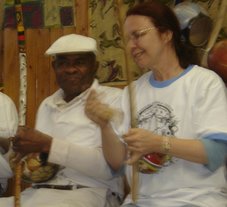
Cobrina and Joao Grande in 1986

"Eu vou pra Bahia"*

I suppose the time has come to explain how I wound up in Bahia. The briefest reason I can give is that I sang "Eu vou pra Bahia" so often when playing berimbau that I brainwashed myself into going.

Capoeira had led me to Jorge Amado, whose novel Tent of Miracles introduced me to Manuel Querino, who became the inspiration and focal point of my MA research. Ironically, I knew much more about Brazil when I was up to my eyebrows in books and writing my MA paper. Once I'd graduated, the details were already starting to fade as I was finally being recognised as a Brazilianist by my friends and employers at the Centre for African American Studies (CAAS), who invited me to give a lecture on Querino to celebrate and mark my newfound status.

That lecture was the beginning of the end, because one of the people who happened to be in the audience was Consuelo Novais Sampaio, a visiting professor of History from the Federal University at Bahia, and a good friend of my MA advisor (who also introduced my lecture), E. Bradford Burns. When I told her that I was thinking of going to Nigeria to study Yoruba, she said, "Why not study it in Bahia? They teach it at the Centre for Afro-Oriental Studies!"

I didn't need much persuading. The entire reason for making Brazil the focus of my MA in Latin American Studies was to get a grant to visit the country. Unfortunately for me, the topic I chose - Brazilian race relations - was so sensitive at the time that the soon-to-be-defunct military government rejected any scholars intending to study that subject. My advisors - particularly E. Bradford Burns and Johannes Wilbert - suggested that I water down my proposal to make it more palatable.

Either because my heart wasn't in it, or the Brazilian government saw right through me, it was rejected and I finished my MA and graduated without setting foot in that oft-sung land. I ended up paying for the trip with money obtained from a grant to study Yoruba at UCLA and - in true LA style - a game show. My 31st birthday party at CAAS was also a bon-voyage party. I left for Brazil on Tuesday, December 7th, 1986, intending to spend three months in Bahia doing preliminary research for a PhD in History. I was already enrolled and planned to get started on it as soon as I got back; but as Robbie Burns once wrote, the best-laid plans "aft gang a-glee". I decided that, instead of studying the place and its people, I would rather be a part of it. Since then, I have learnt and grown a great deal from living in a society to which I will never fully belong. The following entries will contain excerpts from the diary I wrote at the time.


*I'm off to Bahia