Monday, 18 June 2007


"Eu vou pra Bahia"*
I suppose the time has come to explain how I wound up in Bahia. The briefest reason I can give is that I sang "Eu vou pra Bahia" so often when playing berimbau that I brainwashed myself into going.
Capoeira had led me to Jorge Amado, whose novel Tent of Miracles introduced me to Manuel Querino, who became the inspiration and focal point of my MA research. Ironically, I knew much more about Brazil when I was up to my eyebrows in books and writing my MA paper. Once I'd graduated, the details were already starting to fade as I was finally being recognised as a Brazilianist by my friends and employers at the Centre for African American Studies (CAAS), who invited me to give a lecture on Querino to celebrate and mark my newfound status.
That lecture was the beginning of the end, because one of the people who happened to be in the audience was Consuelo Novais Sampaio, a visiting professor of History from the Federal University at Bahia, and a good friend of my MA advisor (who also introduced my lecture), E. Bradford Burns. When I told her that I was thinking of going to Nigeria to study Yoruba, she said, "Why not study it in Bahia? They teach it at the Centre for Afro-Oriental Studies!"
I didn't need much persuading. The entire reason for making Brazil the focus of my MA in Latin American Studies was to get a grant to visit the country. Unfortunately for me, the topic I chose - Brazilian race relations - was so sensitive at the time that the soon-to-be-defunct military government rejected any scholars intending to study that subject. My advisors - particularly E. Bradford Burns and Johannes Wilbert - suggested that I water down my proposal to make it more palatable.
Either because my heart wasn't in it, or the Brazilian government saw right through me, it was rejected and I finished my MA and graduated without setting foot in that oft-sung land. I ended up paying for the trip with money obtained from a grant to study Yoruba at UCLA and - in true LA style - a game show. My 31st birthday party at CAAS was also a bon-voyage party. I left for Brazil on Tuesday, December 7th, 1986, intending to spend three months in Bahia doing preliminary research for a PhD in History. I was already enrolled and planned to get started on it as soon as I got back; but as Robbie Burns once wrote, the best-laid plans "aft gang a-glee". I decided that, instead of studying the place and its people, I would rather be a part of it. Since then, I have learnt and grown a great deal from living in a society to which I will never fully belong. The following entries will contain excerpts from the diary I wrote at the time.
*I'm off to Bahia
Capoeira had led me to Jorge Amado, whose novel Tent of Miracles introduced me to Manuel Querino, who became the inspiration and focal point of my MA research. Ironically, I knew much more about Brazil when I was up to my eyebrows in books and writing my MA paper. Once I'd graduated, the details were already starting to fade as I was finally being recognised as a Brazilianist by my friends and employers at the Centre for African American Studies (CAAS), who invited me to give a lecture on Querino to celebrate and mark my newfound status.
That lecture was the beginning of the end, because one of the people who happened to be in the audience was Consuelo Novais Sampaio, a visiting professor of History from the Federal University at Bahia, and a good friend of my MA advisor (who also introduced my lecture), E. Bradford Burns. When I told her that I was thinking of going to Nigeria to study Yoruba, she said, "Why not study it in Bahia? They teach it at the Centre for Afro-Oriental Studies!"
I didn't need much persuading. The entire reason for making Brazil the focus of my MA in Latin American Studies was to get a grant to visit the country. Unfortunately for me, the topic I chose - Brazilian race relations - was so sensitive at the time that the soon-to-be-defunct military government rejected any scholars intending to study that subject. My advisors - particularly E. Bradford Burns and Johannes Wilbert - suggested that I water down my proposal to make it more palatable.
Either because my heart wasn't in it, or the Brazilian government saw right through me, it was rejected and I finished my MA and graduated without setting foot in that oft-sung land. I ended up paying for the trip with money obtained from a grant to study Yoruba at UCLA and - in true LA style - a game show. My 31st birthday party at CAAS was also a bon-voyage party. I left for Brazil on Tuesday, December 7th, 1986, intending to spend three months in Bahia doing preliminary research for a PhD in History. I was already enrolled and planned to get started on it as soon as I got back; but as Robbie Burns once wrote, the best-laid plans "aft gang a-glee". I decided that, instead of studying the place and its people, I would rather be a part of it. Since then, I have learnt and grown a great deal from living in a society to which I will never fully belong. The following entries will contain excerpts from the diary I wrote at the time.
*I'm off to Bahia
Capoeira, California style

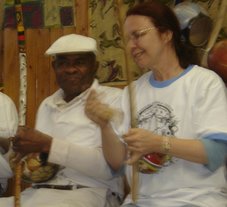
Back in the early to mid-80s,* the main Capoeira group in California was the World Capoeira Association, founded in San Francisco** by Mestre Acordeon, aka Bira Almeida (shown in the above photo), the Brazilian author of the polemically titled book Capoeira: A Brazilian Art Form. Acordeon organised a major Capoeira gathering in 1986, way up in wine country. As usual I was the designated driver, so a bunch of Capoeiristas piled into my Dad's Cutlass Supreme (complete with cruise control) and we cruised up the coast to Frisco.
Acordeon’s school was located in the Mission district, but the venue for the event was a castle-like facility (complete with sauna) north of the Napa Valley, owned by a Bagwan-like cult. Capoeristas from all over the country took part. In those days, they boiled down to Jelom Vieira's group from NYC and students and mestres from LA and San Francisco. There seemed to be a healthy, friendly rivalry between Acordeon and Jelom. I thought it was funny that, in most of Jelom's rodas, the opponents ended up wrestling on the ground - especially when his opponent was Acordeon! I haven't seen that style of Capoeira before or since, but it was also the denouement of Ag'ya as filmed by Katherine Dunham, so I can't say it wasn't authentic.
The other leading Brazilian Capoeira mestre in California was Henrique do Nascimento, whose father, the poet, activist, sculptor, actor, scholar and politician Abdias do Nascimento, is a fascinating figure who unfortunately does not otherwise fit into this particular narrative. Henrique was involved in several Capoeira events in Los Angeles, but I don't remember seeing him play. I do recall going to a party at his home and tasting a batida (a potent mix of cachaça and lime juice) for the first time. Naively assuming it was lemonade, I took a hefty swig, and spent the rest of the party trying to sober up so I could drive home!
Back then, the most important characteristic of Capoeira in the USA was that it was dominated by Regional mestres. The only teacher who gave us a glimpse of Capoeira Angola was Paris. Even so, I got it into my head that Angola was the truly authentic style, and when I made plans to go to Brazil, it was Angola that I wanted to learn.
*I left the US for Brazil in December 1986, to give a more specific timeframe.
**Mestre Moraes once told me that this was like founding the International Hot Dog Association in Brazil - an apt analogy on more than one level.
Friday, 8 June 2007
More musings on "race"
What, you may ask, do these endless musings have to do with Capoeira? Everything, in my opinion, because "race" relations and perceptions have always tinged my interaction with that African-Brazilian martial art, as a melanin-challenged "white" woman (more like undercooked crisp-colour)."From a genetic perspective, all humans are Africans,
either residing in Africa or in recent exile"
Svante Paabo, Anthropologist
To start off this bout of musings, let me say that I consider myself bright, with occasional sparks of brilliance and more than occasional plunges into abysmal idiocy. I can back up my claim to being bright with IQ results (135, which is nowhere near genius but good enough for the likes of me) and a first-class degree in English literature, albeit from a US university, which makes it a "summa cum laude". Like most Mensa candidates, I'm socially awkward, if not inept, but working on it, and that process is aided by the maturity that comes with over half a century of life in this cruel, sometimes tender and always chaotic world.
In addition to being blessed and cursed with intelligence, I have also enjoyed the considerable privilege of growing up in the Caribbean, specifically in bilingual and multiracial Puerto Rico, aka Borinquen, my lovely island, the birthplace of my brothers and sister and homeland of my heart. It would have been paradise if it weren't for the colonisers, but that's another story. (El Gran Combo is singing "Que Viva Puerto Rico" as I write)
Thanks to that combination of nature and nurture, I grew up with what I could call my only "super-power": X-ray vision. Instead of being "colour-blind", I see right past colour to the inner human essence that makes all people members of the human race - the only "race" there is (a view borne out by human genome studies). Which is not to say that I'm incapable of seeing the surface - just that I am capable of finding it beautiful, no matter what colour it is (white, black, brown, yellow, red, but probably not green or purple).
I may be more evolved than most or just an anomaly, but unfortunately I haven't met many people who share my "ability". Instead, "black" people tend to think that I have a "thing" for them, particularly men (something like the viewpoint expressed in the title of Spike Lee's film Jungle Fever), and most "white" people think I am at best eccentric (a euphemism for "barking mad"), or at worst a criminal or "race traitor".
I have fewer problems in this regard in Brazil, where I have always embraced and taken part in Afro-Bahian culture - for many years I chose to live it instead of studying it, and it has been a very enriching and fulfilling experience. While in Los Angeles, I ran into many barriers set up by African-Americans who - mostly because they have been traumatised by the pathological and tragic version of race relations that has developed in the US over the centuries - don't like to see "white" people anywhere near them, and are particularly offended by a pale face in the crowd when they are celebrating their history, community and culture. (I once witnessed the heartbreaking exclusion of a black student's white mother from an African-American-only graduation ceremony at UCLA.)
I was almost barred at the gate (literally) when I went along with my Capoeira group to give a presentation in LA in the early 80s. It all started when we were invited to perform at a celebration of African-American cultural expressions. We all piled into a car or two - my memory is hazy but "we" probably meant Cedric, Odie, Cornell, Steve, and yours truly - and drove off to the event. I often chauffeured for Capoeira players - particularly on trips to San Francisco - but on this occasion I’m fairly sure I was a passenger. Which accounts for my desperation when we arrived at the front gate and someone said, "Not her. She can’t come in." There was no muttering about "white devils", as I’d heard on another occasion, but it was clear that my pale skin was not welcome there. But then someone saved the day by arguing, "Hey, we need her to play berimbau so we can play in the roda." It was true - I could still play the instrument much better than I performed the martial art, and since someone had to do it, I would free up the African-American Capoeiristas to perform. The objections faded in the face of this argument, and the organisers let me in.
I should also say - and this is very important - that the occasions on which I have been "barred at the gate" on account of my colour were, and still are, more than compensated by the wonderful friends I have made as a result of my "gift". When people of African descent are able to overcome the trauma triggered by the sight of my "white" skin, and accept me as a sincere friend and an ardent admirer of their culture, they become more than friends - they're family.
Friday, 1 June 2007
Interlude (part 2): Musings on "gender"*
Yesterday, at the CSA conference, I heard a very interesting talk on "Honour, Gender and Combat" by T.J. Desch Obi. I hadn't noticed that there was a panel including three Capoeira-related subjects scheduled for 11:15 am on Thursday on the 54-page programme until my friend and colleague Danny Dawson pointed it out to me, for which I am profoundly grateful. (Unfortunately, the only talk that focussed specifically on Capoeira was cancelled - the panelist did not turn up.)
Obi's talk ties into the work that another friend, Marcus Trower, is doing on wrestling - he also includes the role of women in what I will loosely describe as martial arts. According to Marcus's book, The Last Wrestlers, women serve more as a goad and/or prize for wrestlers, particularly in Nigeria (see his comment below).
According to Obi, women are (or were) mainly involved in Trinidadian kalenda stick fighting as the elite male fighters' "sugar mommas", but some were fighters themselves. Called jamettes, they sang kalenda war songs, which formed the basis of calypso, and were led by an older woman called a matador. Sometimes the jamettes had to beat their kept kalenda fighters with their own sticks to keep them in line.
I was fascinated by Obi's emphasis on the "femininity" of the jamettes. He stressed that the women's involvement in kalenda did not "masculinise" them. As a contribution to Obi's very interesting research, I offer these musings on gender and femininity.
Women have always been warriors. Like the lioness, who does the hunting and rearing, women have to be able to defend themselves and their young. Being weaker (on the whole) than men just makes that all the more necessary. Just as kalenda fighting involves more than sticks - an "insult fight" similar to playing the dozens is a key factor - self-defence does not always involve brute force. Forms of mental/psychological manipulation commonly known as "women's wiles" are equally effective weapons. "Women's intuition" is an effective way of staying out of trouble, or dodging a blow without seeing it coming. Women also have a higher threshhold of pain than men - or so I'm told - and childbirth bears this out.
In my experience, most of the girls and women I've known who got involved in martial arts have been extremely feminine. The main problem for women in Capoeira is developing upper body strength, but the majority of the women I've met who became deeply involved in it - whether straight, lesbian or bisexual - were all paragons of "femininity". In other words, with one or two exceptions, they didn't imitate men in their dress or behaviour, and they very much liked men, whether as mates or lovers.
Ironically, as I'll describe in more detail when I get to it, I was forced to stop practising Capoeira physically because of two inherent conditions of womanhood - pregnancy, followed by the need to support my child and husband (like a jamette). However, as I hope to show in this blog, I've never stopped practising it mentally. I still try to think like a warrior, although I've laid down my metaphorical kalenda sticks. And I still wear lip gloss and earrings ;-)
*Funny how "gender" usually means "women"!
Obi's talk ties into the work that another friend, Marcus Trower, is doing on wrestling - he also includes the role of women in what I will loosely describe as martial arts. According to Marcus's book, The Last Wrestlers, women serve more as a goad and/or prize for wrestlers, particularly in Nigeria (see his comment below).
According to Obi, women are (or were) mainly involved in Trinidadian kalenda stick fighting as the elite male fighters' "sugar mommas", but some were fighters themselves. Called jamettes, they sang kalenda war songs, which formed the basis of calypso, and were led by an older woman called a matador. Sometimes the jamettes had to beat their kept kalenda fighters with their own sticks to keep them in line.
I was fascinated by Obi's emphasis on the "femininity" of the jamettes. He stressed that the women's involvement in kalenda did not "masculinise" them. As a contribution to Obi's very interesting research, I offer these musings on gender and femininity.
Women have always been warriors. Like the lioness, who does the hunting and rearing, women have to be able to defend themselves and their young. Being weaker (on the whole) than men just makes that all the more necessary. Just as kalenda fighting involves more than sticks - an "insult fight" similar to playing the dozens is a key factor - self-defence does not always involve brute force. Forms of mental/psychological manipulation commonly known as "women's wiles" are equally effective weapons. "Women's intuition" is an effective way of staying out of trouble, or dodging a blow without seeing it coming. Women also have a higher threshhold of pain than men - or so I'm told - and childbirth bears this out.
In my experience, most of the girls and women I've known who got involved in martial arts have been extremely feminine. The main problem for women in Capoeira is developing upper body strength, but the majority of the women I've met who became deeply involved in it - whether straight, lesbian or bisexual - were all paragons of "femininity". In other words, with one or two exceptions, they didn't imitate men in their dress or behaviour, and they very much liked men, whether as mates or lovers.
Ironically, as I'll describe in more detail when I get to it, I was forced to stop practising Capoeira physically because of two inherent conditions of womanhood - pregnancy, followed by the need to support my child and husband (like a jamette). However, as I hope to show in this blog, I've never stopped practising it mentally. I still try to think like a warrior, although I've laid down my metaphorical kalenda sticks. And I still wear lip gloss and earrings ;-)
*Funny how "gender" usually means "women"!
Thursday, 31 May 2007
Interlude (part 1): Musings on "race"*
The good thing about a blog is that, being a bit like a journal, it can include past and present events. I'm attending the Caribbean Studies Association conference in Salvador this week and have had at least two opportunities to discuss and learn about different aspects of Capoeira. The resulting musings promise (or threaten) to be longer than I'd originally planned, so I'll divide them into parts - the first on "race" and the second on "gender".
On Tuesday morning, I had a very interesting discussion with La Vinia Delois Jennings that covered, among other things, the political aspects of associating or divorcing Capoeira with/from its African roots.
In the US, Capoeira is often used by African-Americans and appropriated by a group that a friend calls "Africans with a k" as an affirmation of African culture and identity. This is all well and good, except that many of them buy into the Regional spiel that Capoeira was developed in Brazil by Africans whose hands were always shackled, so they fought with their feet instead.
In Brazil, the same government that legalised Capoeira in the 30s also made a strenuous effort to "regionalise" and "Brasilianise" it. My theory is that, since Capoeira was being co-opted and "decriminalised" so it could packaged as a commodity to be sold to the middle classes, it would be more palatable to non-blacks if it were presented as Brazilian and not Afro-Brazilian. The title of Capoeira: A Brazilian Art Form by Bira Almeida (aka Mestre Acordeão) evokes howls of outrage outside Brazil but clearly expresses the Regional viewpoint.
I've heard more than one Regional mestre (both in person and in televised documentaries) claim that the Africans who supposedly invented Capoeira in Brazil were imitating monkeys, stingrays, goats, etc. In other words, the presupposition is that they lacked such moves in their cultural repertoire, so they had to learn them from the beasts of the earth and the fish of the sea! One (white) Regional mestre, who shall remain nameless, had the gall to say that the masters should be thanked for whipping their slaves and forcing them to develop a martial art.
Here, in a nutshell, is the response I've come up with over the years - not being one for quick, off-the-cuff retorts: After visiting Nigeria about 17 years ago and hearing that people in rural areas engage in a similar form of martial art, and also learning of the existence of N'golo in what is now Angola, I am convinced that Africans from several parts of the continent pooled and fused their knowledge to develop what we now know as Capoeira. Not only did they bring the knowledge with them, but enslaved Africans and their descendants rarely went about with their hands in shackles. For one thing, it would make it awfully hard to swing a machete in the cane fields, or stuff sugarcane stalks into a mill, etc. etc.
Also, many were sent out into the streets as slaves-for-hire and led relatively independent lives, bound only to deliver a specific sum of money to their "owners" on a weekly or monthly basis. Slavery was not a monolith in Brazil. By the time it was abolished in 1888, thousands of Africans and their descendants had been freed by a) purchasing or being granted manumission or b) qualifying for freedom under the "free womb" and "sexagenarian" laws, etc. etc. In fact, some slave traders and slaveowners were black.
Therefore, there is no question in my mind about the "Africanness" of Capoeira - despite its indigenous name - but its history is still shackled (pardon the pun) by serious misconceptions about the realities of slavery in Brazil.
*I put "race" in quotes because I believe the human race should not be subdivided.
On Tuesday morning, I had a very interesting discussion with La Vinia Delois Jennings that covered, among other things, the political aspects of associating or divorcing Capoeira with/from its African roots.
In the US, Capoeira is often used by African-Americans and appropriated by a group that a friend calls "Africans with a k" as an affirmation of African culture and identity. This is all well and good, except that many of them buy into the Regional spiel that Capoeira was developed in Brazil by Africans whose hands were always shackled, so they fought with their feet instead.
In Brazil, the same government that legalised Capoeira in the 30s also made a strenuous effort to "regionalise" and "Brasilianise" it. My theory is that, since Capoeira was being co-opted and "decriminalised" so it could packaged as a commodity to be sold to the middle classes, it would be more palatable to non-blacks if it were presented as Brazilian and not Afro-Brazilian. The title of Capoeira: A Brazilian Art Form by Bira Almeida (aka Mestre Acordeão) evokes howls of outrage outside Brazil but clearly expresses the Regional viewpoint.
I've heard more than one Regional mestre (both in person and in televised documentaries) claim that the Africans who supposedly invented Capoeira in Brazil were imitating monkeys, stingrays, goats, etc. In other words, the presupposition is that they lacked such moves in their cultural repertoire, so they had to learn them from the beasts of the earth and the fish of the sea! One (white) Regional mestre, who shall remain nameless, had the gall to say that the masters should be thanked for whipping their slaves and forcing them to develop a martial art.
Here, in a nutshell, is the response I've come up with over the years - not being one for quick, off-the-cuff retorts: After visiting Nigeria about 17 years ago and hearing that people in rural areas engage in a similar form of martial art, and also learning of the existence of N'golo in what is now Angola, I am convinced that Africans from several parts of the continent pooled and fused their knowledge to develop what we now know as Capoeira. Not only did they bring the knowledge with them, but enslaved Africans and their descendants rarely went about with their hands in shackles. For one thing, it would make it awfully hard to swing a machete in the cane fields, or stuff sugarcane stalks into a mill, etc. etc.
Also, many were sent out into the streets as slaves-for-hire and led relatively independent lives, bound only to deliver a specific sum of money to their "owners" on a weekly or monthly basis. Slavery was not a monolith in Brazil. By the time it was abolished in 1888, thousands of Africans and their descendants had been freed by a) purchasing or being granted manumission or b) qualifying for freedom under the "free womb" and "sexagenarian" laws, etc. etc. In fact, some slave traders and slaveowners were black.
Therefore, there is no question in my mind about the "Africanness" of Capoeira - despite its indigenous name - but its history is still shackled (pardon the pun) by serious misconceptions about the realities of slavery in Brazil.
*I put "race" in quotes because I believe the human race should not be subdivided.
Sunday, 20 May 2007
Subscribe to:
Posts (Atom)